Tuesday, August 21, 2012
Congressman Gohmert and Staff Visits Weevil Rearing Facility
While the Congressman has been on Caddo Lake many times and seen the perils of giant salvinia first hand, many of his Staff have not. This stop on the Congressman's trip gave some of his staff the opportunity to see giant salvinia up close and personal while also getting out on Caddo Lake to enjoy its unique beauty.
The first stop on the tour was the giant salvinia weevil rearing facilities green houses. The Congressman and his staff were briefed on the operations of the green houses and weevil production by Mr. Lee Eisenberg. Also mentioned was the great collaboration that has gone into the establishment and operation of the facility. The Texas Parks and Wildlife Department, the Caddo Lake Institute, U.S. Fish and Wildlife's Caddo Lake National Wildlife Refuge staff and many local volunteers were of great assistance to Texas A&M University personnel in getting the facility constructed and underway.
Moving indoors to the Caddo Lake National Wildlife Refuge headquarters and the lab we have set up there, Lee continued discussions on how weevils are sampled. An adult weevil and weevil larvae were also available to view under a microscope. Adult weevils are about 2 mm in length, so getting a really good look at them requires magnification.
Following the brief stint in the lab, the visit to the weevil rearing facility wrapped up with a short presentation and video. Dr. Allen Knutson discussed work that he and Dr. Abhishek Mukherjee are conducting to evaluate the cold tolerance of the salvinia weevil. Initial findings indicate that weevils from different geographic locations are adapted to their specific climates making some more cold tolerant than others. The video shown (same video as the previous post) highlighted the current giant salvinia situation on Caddo Lake.
Before the Congressman and his staff departed, we took a short boat tour of Caddo Lake. Joining in on the tour was newly elected Texas House of Representatives Member Elect Chris Paddie. He will be representing House District 9 in the coming session. Given the time available, we weren't able to get the group out to the areas of the lake where giant salvinia is really bad. Regardless, everyone was able to truly enjoy Caddo Lake.
Monday, August 13, 2012
Video of Giant Salvinia and Other Invasives
What the video shows is somewhat disturbing in that it shows extensive amounts of giant salvinia along with plenty of other invasive plants. Aside from giant salvinia, alligator weed and American lotus are also problematic this year. In many cases, the alligator weed and lotus are so thick, that it is hard to see the giant salvinia. Anyway, watch the video and then read the rest of the post.
So the video shows some pretty extensive mats of giant salvinia and plenty of other aquatic vegetation. One good thing to note about this video is that salvinia weevils are actively being released into the Bird Roost area of Caddo Lake (where the worst of the giant salvinia was in the video). Two releases have been made this year and at least one more will be made before the growing season ends further increasing weevil numbers. Weevils have shown the ability to persist in this area of the lake through the winter and certainly have plenty of food/habitat here. As a result, weevil populations have the needed ingredients to expand on their own in this location. Additionally, this part of the lake is relatively isolated from the rest of the lake making an ideal weevil nursery.
As more weevils are released, chances of keeping giant salvinia in control increase; however, this is certainly an uphill battle. Continuing to treat giant salvinia with biological and chemical means while educating the public about the perils of giant salvinia are a must.
Please share this video with your friends and family and help show how this plant can take over a waterbody.
Monday, July 30, 2012
Aquatic Vegetation Management Webinar
Friday, July 20, 2012
The good, the bad and well, the bad
Before we get to the bad news, lets highlight some positives. Giant salvinia collected on the lake in early February 2012 was processed and live weevils were found in the plant material. Granted, there weren't that many but some were alive and well and we certainly see that as a success. Samples collected again in April also produced a couple live weevils. The numbers were much fewer than in February, but between the two sampling dates, large rains and high water move the salvinia around and further dispersed the weevils.
| Salvinia collection in early April. Dr. Allen Knutson collects salvinia in the front of the boat and Mr. Lee Eisenberg records data in the back. |
As seen in the photo above, large mats of giant salvinia 10 to 20 acres in size were starting to form in the Clinton Lake area by early April (this is part of the bad news in case you were wondering!). With this information in hand, the wheels were put in motion to begin the fight against giant salvinia early in the year using any means available.
Beginning in May, large scale chemical applications began on Caddo Lake. The Cypress Valley Navigation District began treating vegetation along boat roads and in other critical areas to protect lake access and navigation. In addition, the Center for Invasive Species Eradication contracted with SprayCo to treat the large giant salvinia infestation in the Clinton Lake area. Over the course of May and June, SprayCo treated approximately 696 acres of giant salvinia. It would be fantastic if we could say that we got all of the salvinia treated and killed, but we cannot (this is also the bad news).
Also used in to fight giant salvinia are the salvinia weevils being grown at the Caddo Lake National Wildlife Refuge at the our weevil rearing facility there. Under the direction of Mr. Lee Eisenberg, two harvests and releases have been made this spring. On May 22nd and 23rd, approximately 31,300 adult weevils and countless larvae and eggs were release in the Bird Roost area. On July 18th, another batch of weevils were released near the first release site. This site is being used as a nursery area for the weevils due to its remote location, limited boat traffic and the fact that flood waters usually push salvinia out of this area into other parts of the lake. The thought is that flood waters will naturally disperse weevils across the lake once they are established in this area.
![]() |
| Mr. Lee Eisenberg harvests weevil infested giant salvinia at Caddo Lake NWR weevil rearing facility on July 18, 2012 for distribution on Caddo Lake. |
So as the summer continues, the fight will continue with everything and the kitchen sink being thrown at this stuff.
Monday, February 6, 2012
Lake Levels Return to Normal...Giant Salvinia Lies in Wait
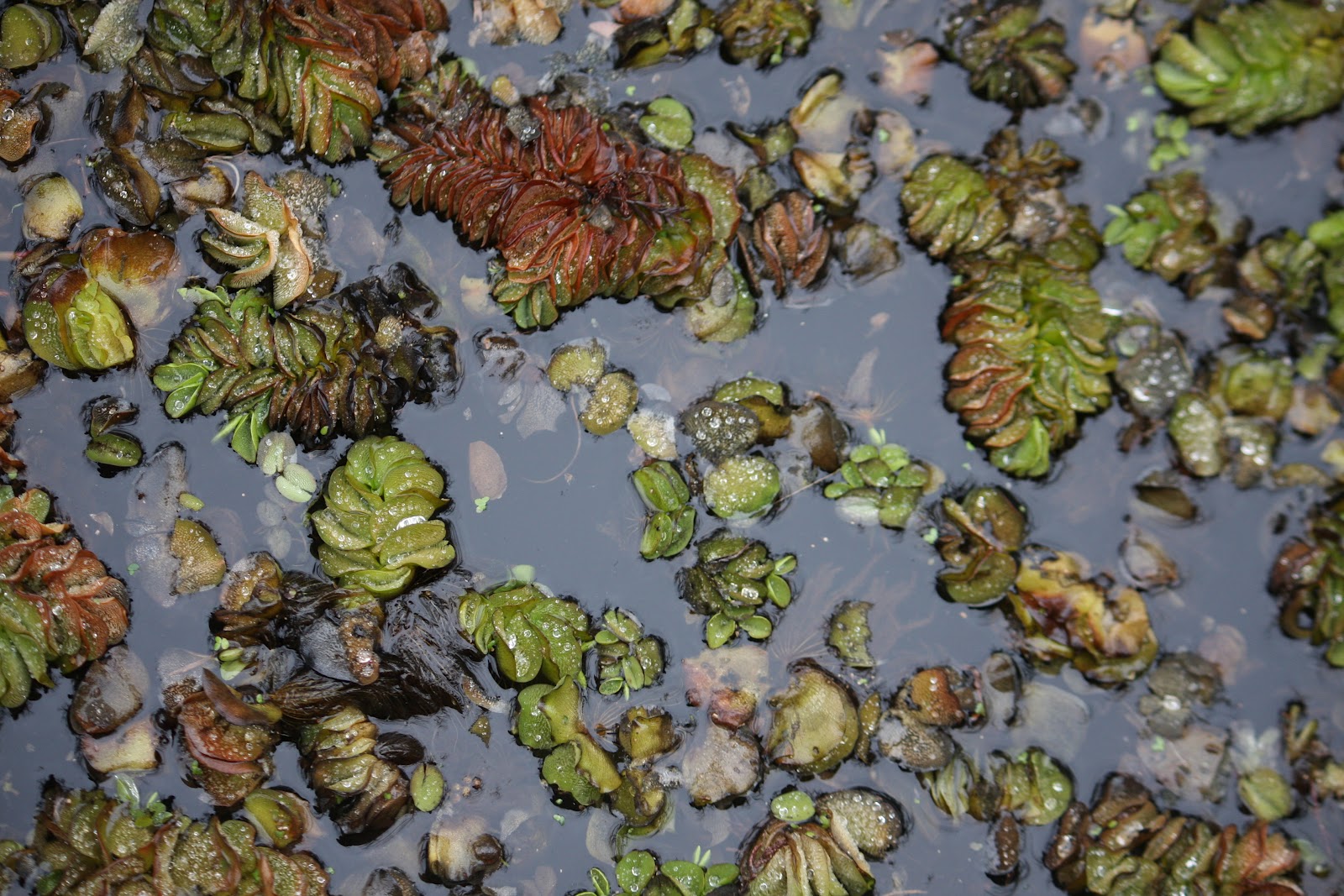
Much of the giant salvinia is also actively growing. The picture below illustrates just this. The upper part of the plant appears to be burned from light freeze damage while the lower part of the plant is actively growing. The four lobes of the plant visible at the bottom of the picture are referred to as "terminal buds" and are the actively growing portion of the plant.
Terminal buds are the plant that salvinia weevils prefer to feed on and lay eggs in. From a perspective of sustaining weevil populations on the lake, it is good to see this growth; however, actively growing salvinia this early in the year is not so good.
The picture below further illustrates the active salvinia growth seen on the lake. The smaller leaves laying flat on the water's surface are primary salvinia that has recently begun to grow. While extensive mats of salvinia are not yet present, it likely won't take long for these mats to start forming.
It is only early February though, so a good killing freeze is not totally out of the question. If a hard freeze like those seen in 2010 or 2011 comes along, the salvinia will likely take a hit.
For now though, giant salvinia on Caddo Lake is alive and well. It is simply biding its time until spring truly arrives.
Friday, November 11, 2011
Thursday, August 18, 2011
Sen. Hutchison Praises Caddo Lake Giant Salvinia Work
Last week we had the privilege of U.S. Sen. Kay Bailey Hutchison visiting Caddo Lake and touring the Center for Invasive Species Eradication’s salvinia weevil-rearing facility located at the wildlife refuge.


Following the tour, Hutchison spoke to a group gathered at the Caddo Lake National Wildlife Refuge about the threat that invasive species such as the giant salvinia pose to the refuge and to Texas lakes.
“While Caddo Lake is home to hundreds of animal, fish and plant species, invasive species threaten this magnificent resource,” said Hutchison. “We are proud to work with the Caddo Lake Institute and Texas A&M University on creating a center of excellence focused on eradicating invasive species.”
You can read the full AgriLife TODAY story for more information. Visit our Facebook page for more photos of the day's events.
Sen. Hutchison also applauded the Caddo Lake Giant Salvinia Eradication Project in her weekly column in the Mineola Monitor, noting that "this promising research will help restore Caddo's habitats and protect this unique natural treasure." Read the full Mineola Monitor article for more information.